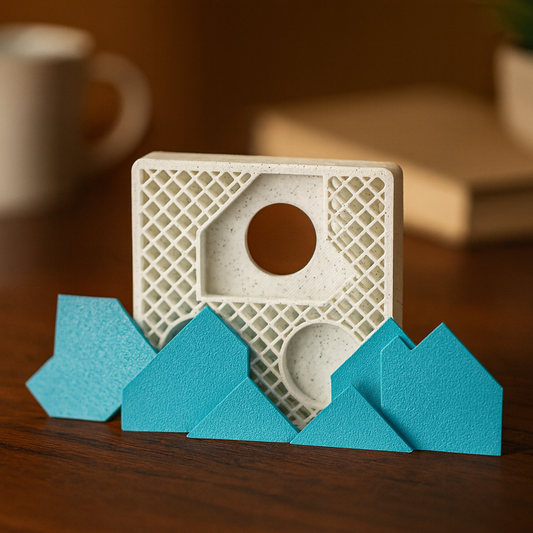
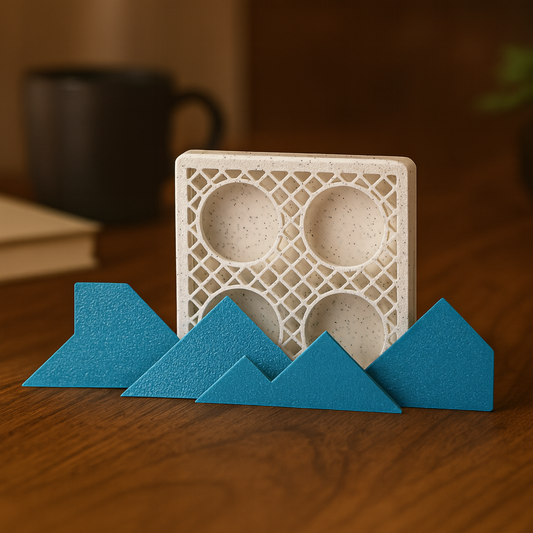
コレクション: 2D Packing Puzzles
A 2D packing puzzle gives you a flat tray and a set of pieces that have to lie inside it in a single layer, with no overlaps and no gaps. One layer sounds like it should make things easier. It mostly removes the escape routes.
Because everything is visible at once, these are the packing puzzles people actually attempt in public. They sit flat on a desk, the pieces do not roll away, and you can leave one half-solved between meetings.
Where to start
Fish Tank and Wild West are the friendly entries at $15. Trivial and Slidely Trivial are small, cheap and much less trivial than the names suggest.
Turbulence and Conga Line are the step up, where the tray shape starts working against you.
Best for
Office workers who want a desk puzzle that does not scatter. Teachers using tiling to teach area. Gift buyers who want something a non-puzzler will actually pick up rather than admire and shelve.
Frequently Asked Questions
What is a 2D packing puzzle?
A puzzle where flat pieces must be arranged inside a tray or frame in a single layer, filling the space exactly with no overlap.
How is it different from a jigsaw?
A jigsaw has one solution and the piece shapes tell you where they go. A packing puzzle gives you pieces that fit in many wrong ways, and nothing on the piece tells you which way is right.
Are they easier than 3D packing puzzles?
Not reliably. You lose a dimension of freedom, but you also lose the option of stacking your way out of a mistake.
Do they ship assembled?
They ship disassembled. The pieces have to be out of the tray for it to be a puzzle.