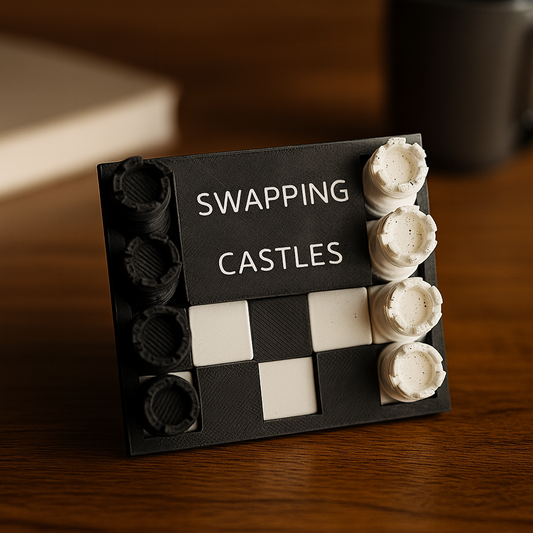
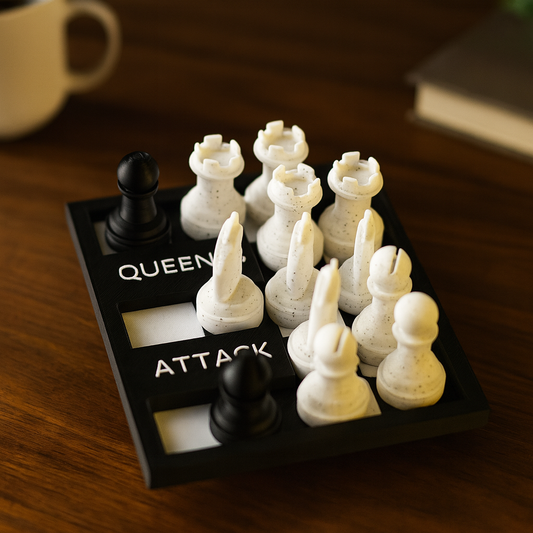
Chess puzzles you solve with your hands, not on a screen. Standard chess moves, real pieces, and a position no actual game would ever produce.
These are not the tactical problems you get on a chess app, where you study a position and find the best move. Here you are given a target arrangement and a set of legal moves, and the work is getting from one to the other without trapping yourself.
Why they are harder than they look
The board is the trick. These are not chessboards, and there is no eight by eight. Each one is a small tray of recessed squares cut to fit the problem and no larger, so the pieces sit in wells with nowhere spare to put anything.
Even the engraved titles earn their place. They sit on raised panels that take up cells, and those cells are walls. On a full open board neither problem is interesting: a pawn walks up an empty file, rooks swap sides in a few moves. Every square the designer declines to give you turns a free move into a negotiation.
All of them are designed by Sherzod Khaydarbekov of Tashkent, Uzbekistan, who has made this his whole territory. There is more on how he builds them in his designer profile.
Where to start
Swapping Castles is the one to take first. Eight rooks, two sides, swap them without captures. It explains itself in a sentence, it travels well, and the failure is instructive: you reach a position where nothing legal helps and have to work out how many moves back the real mistake was.
Queen's Attack is the denser of the two. The queen is missing from the board entirely, her supporting pieces are not, and a single white pawn has to do all the work.
Best for
Chess players who want something physical on the desk rather than another app. People who like logic puzzles and already know how the pieces move. Anyone buying for a chess player who owns three sets already and does not need a fourth.
You do not need to be good at chess. You need to know how the pieces move, which takes about five minutes. Chess players do have an advantage, because board sense is exactly the skill being tested.
Frequently Asked Questions
What is a physical chess puzzle?
A puzzle that uses chess pieces and standard chess moves to set a rearrangement problem, built as an object you handle rather than a position you study. The goal is to reach a target arrangement using only legal moves, usually without captures.
Are these the same as chess problems in a book?
No. A book problem asks for the best move in a position that could occur in a game. These ask you to reach a target arrangement from a position that could never occur. The goal is rearrangement rather than attack, and there is no opponent.
Do you need to know chess to solve them?
Only how the pieces move. No opening theory, no endgame knowledge, no rating required. The goal printed on each puzzle tells you the rest.
How hard are they?
Both are rated Medium. They are not punishing, but they do not fall quickly either, and the difficulty is in planning several moves ahead rather than in spotting one clever idea.
Are chess puzzles a good gift for a chess player?
They are one of the few chess gifts that is not another set or another book. They sit on a desk, they get picked up by other people, and they are solvable in a sitting without needing an opponent.
For the wider category these belong to, see mechanical puzzles, or read two chess puzzles you solve with your hands.