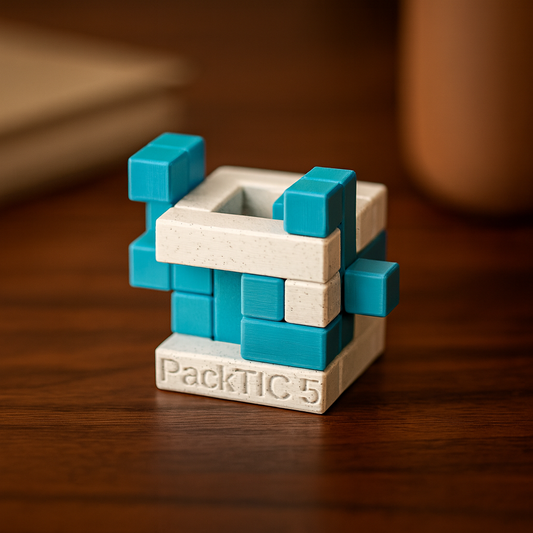
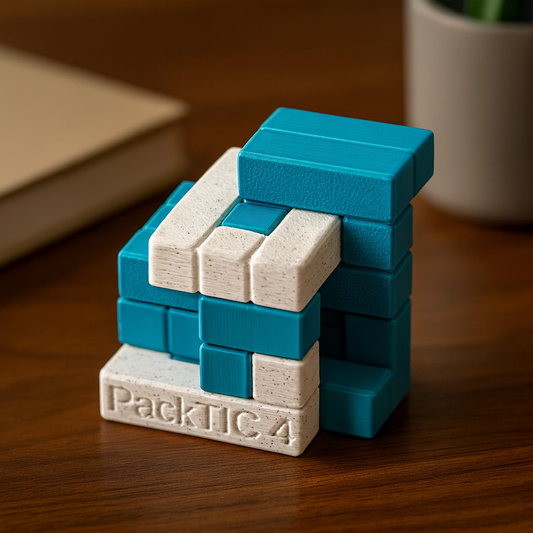
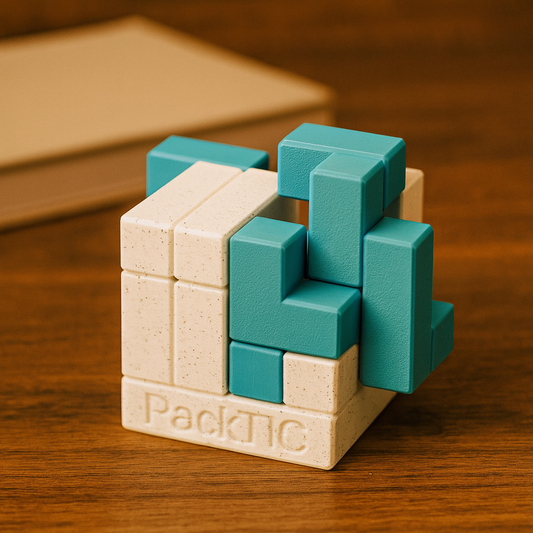
The goal is simple. Fit all the pieces inside the box.
You'll spend the next two hours discovering that simple and easy are not the same thing.
A packing puzzle is a spatial geometry problem in physical form. The pieces look like they should fit. They almost fit. They fit in every configuration except the right one - until suddenly, satisfyingly, they do. That moment is what the whole thing is built for.
Why packing puzzles are different
Most puzzles give you a picture to work toward. Packing puzzles give you a box and a pile of pieces. The solution exists - it's precise, it's elegant, and it's completely non-obvious until you find it.
The designers behind these puzzles are some of the best in the world. Osanori Yamamoto's "hide the holes" series looks minimal and produces some of the most brutal solve experiences in the catalog. Frederic Boucher's gravity-defying designs introduce a physical constraint that changes everything. Lucie Pauwels and Alexander Magyarics each bring a geometric precision that makes you wonder how the solution was ever found in the first place.
These aren't toys. They're problems worth solving.
What Is a Packing Puzzle?
A packing puzzle is a physical puzzle where every piece has to fit inside a defined space - a tray, a frame, a box, or a three dimensional form. The rules are always the same three: use all the pieces, stay inside the boundary, and leave nothing sticking out.
What makes them hard is that the container is never generous. A packing puzzle is designed so the obvious arrangements fail. Pieces that look like they belong side by side do not. Space that looks wasted turns out to be the only place the last piece can go. There is usually exactly one solution, and the puzzle is built specifically so your first instinct is not it.
They are popular with adults because they are honest. No electronics, no hidden catches, no rulebook. You can see the entire problem the moment you open the box, and it still takes hours.
2D and 3D Packing Puzzles
Flat packing puzzles use a tray or frame. Every piece lies on one plane and the challenge is purely about arrangement - which is harder than it sounds, because there is nowhere to hide a mistake. Jigsaw Traffic and Galette are good examples.
Three dimensional packing puzzles use a box, and add stacking and orientation to the problem. A piece can be correct in shape and still wrong in rotation. Some of these are called stacking puzzles, and this is where the longest solve times live.
A third group adds a mechanical constraint on top. Frederic Boucher's gravity defying designs will not let a piece rest where physics says it should, and the MINIMA series adds a sliding restriction so pieces must enter in a specific order. The packing problem is the same. The route to it is not.
Finding your level
New to packing puzzles? Start with a 2 or 3-piece puzzle - deceptively simple, genuinely satisfying. Already solved a few? The 5 and 6-piece designs are where the real difficulty begins. The hard puzzles collection filters to the upper end if you want to go straight there.
All puzzles ship assembled.
Frequently Asked Questions
How hard are packing puzzles?
Difficulty ranges from beginner (2-3 pieces, 20-30 minutes) to genuinely expert (6+ pieces, several hours). Each product page includes a difficulty rating and estimated solve time.
Are packing puzzles good gifts?
Yes - especially for spatial thinkers, engineers, architects, and anyone who enjoys a problem with a clean, satisfying solution. They look great on a desk and work as conversation pieces even before they're solved.
What are some famous packing puzzles?
Hoffman's packing puzzle, described in 1978, uses 27 identical rectangular blocks that must fit inside a cube whose edge equals the sum of the block's three different side lengths. The Slothouber-Graatsma puzzle asks you to pack six 1x2x2 blocks and three 1x1x1 blocks into a 3x3x3 box, and is famous for how much empty space the solution appears to waste.
What is the difference between a packing puzzle and an assembly puzzle?
A packing puzzle has a container. Your pieces must end up inside a box, tray or frame. An assembly puzzle has no container - the pieces themselves form the finished shape. Interlocking puzzles and burrs are assembly puzzles, not packing puzzles.
How do you solve a packing puzzle?
Start with the largest or most awkward piece, since it has the fewest positions available to it. Work out which corners and edges can only be filled one way. Most solvers fail by filling the easy space first and leaving an unusable gap for the final piece, so pay attention to the space you are creating rather than the piece in your hand.
Do packing puzzles ship assembled?
No. Packing puzzles arrive with the pieces out of the box, because a solved puzzle in the box would not be a puzzle. Part of the challenge is that you never see the finished arrangement before you find it yourself.
New to these? What is a packing puzzle →